How to Determine if Your Client is Suitable for Hair Toppers?
Jan 21,2026
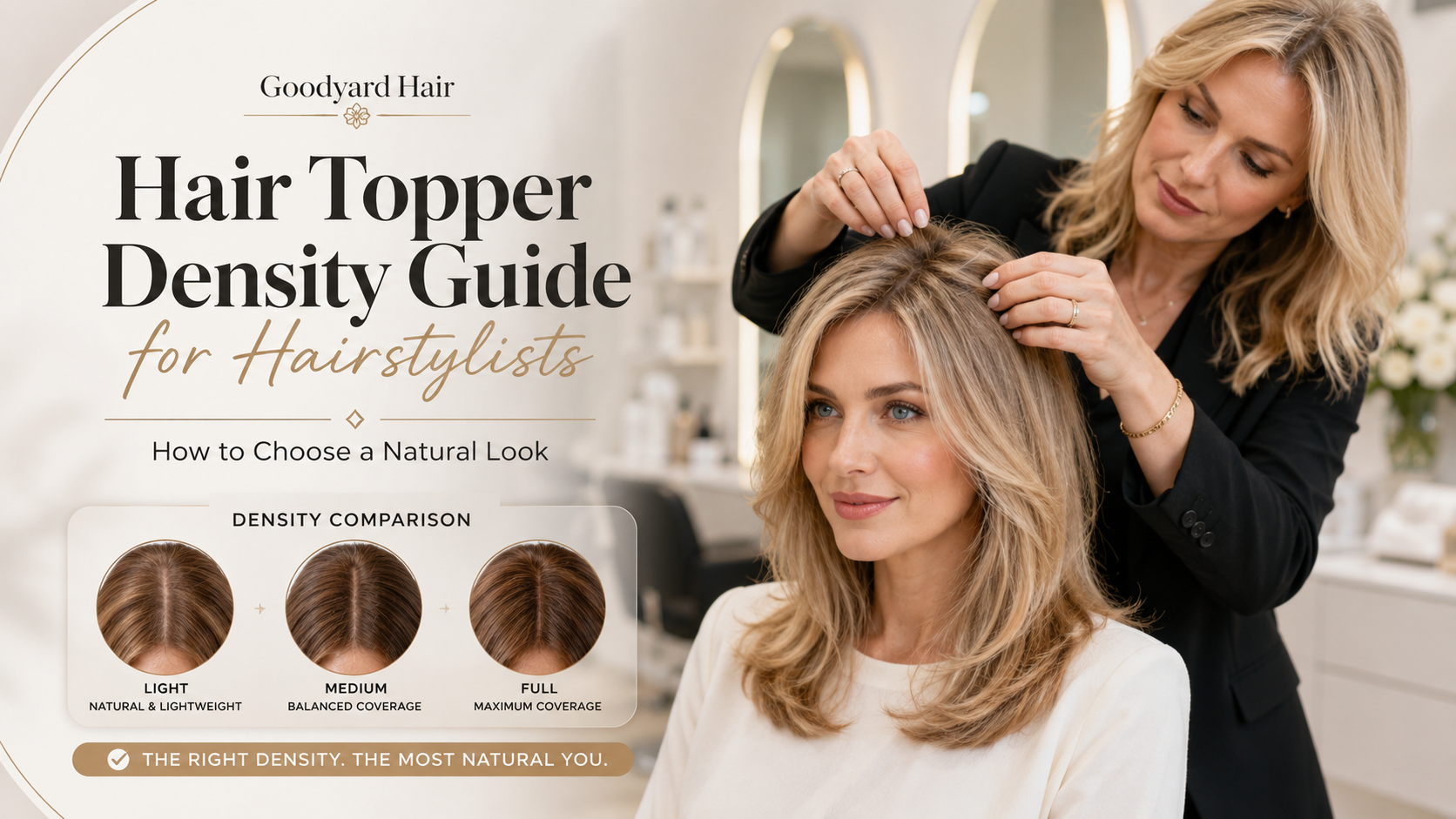
Hair toppers are one of the most natural-looking and effective solutions for women experiencing thinning hair, widening part lines, or reduced crown volume. However, many salons and stylists who are newly offering toppers often face the same challenge: they know toppers are in demand, but they are not sure how to assess a client’s suitability or recommend the right specifications confidently.
This guide will help you evaluate clients step by step, avoid common mistakes, and deliver better results with less trial and error. As a trusted hair toppers manufacturer, Goodyard Hair works closely with professional salons and understands exactly what matters for high-end Caucasian hair needs.
What Is a Hair Topper and Who Is It Designed For?
A hair topper is a partial hairpiece designed to cover thinning or sparse areas on the top of the head, most commonly around the crown or part line. Unlike a full wig, a topper does not replace all of the client’s hair. Instead, it blends with existing hair to add targeted volume and coverage exactly where it is needed.
Hair toppers are ideal for women who want a realistic, lightweight solution that integrates seamlessly into their everyday hairstyle.
Hair Toppers vs. Wigs vs. Extensions: A Quick Salon Comparison
| Solution | Coverage Area | Best For | Key Notes |
| Hair topper | Crown, top, part line | Localized thinning, widening part, crown transparency | Requires enough hair to anchor; blends naturally |
| Full wig | Entire scalp | Advanced hair loss, alopecia, full transformation | Best when topper anchoring is not possible |
| Hair extensions | Mid-lengths and ends | Length, fuller ends, thicker ponytail | Not designed to hide crown thinning |
| Solution | Coverage Area | Best For | Key Notes |
| Hair topper | Crown, top, part line | Localized thinning, widening part, crown transparency | Requires enough hair to anchor; blends naturally |
If the client’s main concern is “my part is wider” or “my crown looks see-through,” a topper is usually the best first recommendation. If the client’s concern is “I want longer hair,” extensions are typically a better match.

The Best Candidates for Hair Toppers: What to Look For
The most successful topper clients usually share three characteristics: a localized thinning pattern, enough anchor hair, and realistic expectations.
1. Thinning Pattern Is Localized, Not Full-Head
Hair toppers work best when thinning is concentrated in specific areas such as:
- The part line
- The crown
- The top of the head
- Mild recession near the temples (depending on the base size)
Clients with early to moderate thinning often achieve the most natural and comfortable results because there is still enough natural hair to blend around the topper perimeter.
When thinning becomes extensive across the entire scalp, or when coverage needs approach full-head replacement, a wig or professional integration system may be more appropriate.

2. The Client Has Enough Healthy Hair for Secure Attachment
A hair topper is not “floating hair.” It needs stability. That stability comes from healthy hair around the thinning area.
A client is more likely to succeed with a topper when:
- There is healthy hair surrounding the thinning zone
- The hair is strong enough to hold clips or salon attachment methods
- The scalp is comfortable and not overly irritated in anchor areas
If the client’s hair is extremely fragile everywhere, or the thinning is so advanced that there are no secure anchor points, the topper may shift, feel uncomfortable, or fail to blend naturally.
3. The Client Wants Targeted Coverage and a Natural Blend
Hair toppers are best for clients who want:
- A natural look that still feels like “their own hair”
- Coverage in one specific zone rather than full-head replacement
- A realistic everyday hairstyle, not a dramatic costume-style change
If a client expects instant, extreme volume while their natural hair is fine and thin, you may need to educate them about choosing the correct density to avoid an obvious mismatch.
Salon Consultation Checklist: How to Assess Suitability in 5 Minutes
A structured consultation builds trust and prevents incorrect recommendations. Use this simple checklist.
Step 1: Identify the Coverage Zone
Ask the client to show you the area they are most concerned about. Common areas include:
- Part line widening
- Crown transparency
- Loss of volume at the top
Then confirm whether the issue is localized or diffuse.
Step 2: Check Anchor Hair Quality
Use your fingers or a tail comb to evaluate hair strength around the thinning area.
Ask yourself:
- Can clips grip securely without pulling?
- Is there enough density around the perimeter for a stable hold?
- Will the client’s natural hair cover the topper edges after blending?
If the answer is yes, the client is likely a good topper candidate.
Step 3: Understand Lifestyle and Wear Preferences
Suitability depends on daily habits. Ask questions such as:
- Do you want to remove the topper at night?
- Are you very active, such as intense workouts or swimming?
- Do you prefer low-maintenance daily routines?
Clients who want flexibility often prefer clip-in toppers. Clients who want maximum security and “wear it continuously” may be better suited for salon-installed options.
Step 4: Confirm Expectations
A successful topper result is about matching reality, not just selling hair.
Ask:
- Are you looking for subtle natural coverage, or dramatic transformation
- Do you want your topper to look like your own hair, or like a fuller new style?
- Are you comfortable with salon blending, trimming, and maintenance?
When expectations are clear, the topper recommendation becomes much easier.
| Evaluation Category | What to Check | Suitable for Hair Toppers | Not Ideal for Hair Toppers | Recommended Alternative |
| Hair loss location | Crown, part line, top | Yes | No, full-head thinning | Wig or integration system |
| Anchor hair | Strength around thinning area | Enough to hold clips | Too weak or too sparse | Wig or professional system |
| Desired result | Natural, realistic blend | Yes | Wants extreme volume only | Custom density or different solution |
| Lifestyle | Daily wear, flexible use | Works well | High-intensity sports without secure installation | Salon-installed system |
| Maintenance willingness | Styling and blending accepted | Yes | Refuses any maintenance | Lower-maintenance option |
Common Mistakes New Stylists Make (and How to Avoid Them)
Mistake 1: Choosing a Base That Is Too Small
A topper that is too small may not fully cover the thinning zone, and the edges may become visible. It also reduces stability because clips sit too close to the thin area.
A better approach is to choose a base size that covers the thinning area completely and allows the perimeter to rest on healthier hair.
Mistake 2: Over-Selecting Density
Many first-time clients think higher density is always better. In reality, high density can look unnatural if the client’s own hair is fine or thin.
For most Caucasian clients seeking a natural everyday look, moderate density is often the safest choice.
Mistake 3: Ignoring Color Dimension
If the client has highlights, balayage, or root shadow, a flat single-color topper may look unnatural even if the base and density are correct.
Professional color matching and multi-dimensional shades often create the most premium finish.
Mistake 4: Not Planning for Blending and Cutting
Even the best topper will not look perfect straight out of the box. For salon-quality results, plan for:
- Light layering
- Face framing
- Texture matching
- Seamless perimeter blending
This is one of the biggest reasons salons can outperform online direct-to-consumer purchases.
When Hair Toppers Are Not the Best Choice
A professional stylist should also know when to recommend a different solution.
Hair toppers may not be ideal if:
- The client has near-total hair loss on the top and sides
- There is not enough hair to anchor clips or installation points
- The client needs full hairline reconstruction
- The scalp is extremely sensitive and cannot tolerate attachment tension
In these cases, a full wig or medical-grade hair system may be a better solution for comfort, security, and appearance.
Why Quality Matters for High-End Salon Clients
For premium salons, success depends on natural results, longevity, and client trust. That is why the supplier matters as much as the styling technique.
As a professional hair toppers manufacturer, Goodyard Hair focuses on:
- High-quality virgin Remy human hair
- Natural blending performance for Caucasian hair textures
- Stable craftsmanship for long-term salon use
- Consistent color and quality control for repeat orders
If your salon is building a topper service menu, working with a reliable hair topper supplier helps you reduce quality issues, improve client retention, and scale your business.
We support professional partners with wholesale hair toppers for salons that demand premium results and consistent supply.
Final Salon Recommendation: A Simple Rule to Remember
A client is usually suitable for hair toppers when:
- The thinning is localized at the crown or part line
- There is enough healthy hair to anchor and blend
- The client wants realistic, targeted coverage
- Expectations match what a topper is designed to do
When these conditions are met, hair toppers can become one of the highest-satisfaction and highest-repeat services in your salon.
Work With a Trusted Hair Topper Factory
Goodyard Hair is a professional hair topper factory in China, supplying high-end salons with premium toppers made from the highest quality virgin Remy human hair.
If you are looking for a long-term partner for consistent quality and professional support, we welcome salon inquiries for wholesale hair toppers.

Comment